

SEO and paid advertising both play important roles in digital marketing. While SEO builds long-term organic visibility and credibility, paid advertising delivers faster visibility and targeted traffic. Discover the key...
Industrial environments benefit most from connected automation. We build IoT systems that monitor equipment, trigger automated responses, and feed operational data into your existing systems — turning a factory floor into a data source.
Equipment failures that could be detected hours in advance with sensors are instead discovered when a line goes down. Maintenance is scheduled by calendar, not condition. Operational data lives in operator logbooks and shift reports, not systems where it can drive decisions. We change this — by making every machine a data source and every anomaly an automatic action.
Average cost of one hour of unplanned production downtime
Of machine failures are detectable 24+ hours in advance with sensor data
Typical reduction in maintenance costs after predictive monitoring deployment
Industrial IoT delivers value through four capabilities that work together — equipment visibility generates the data, automated triggers act on it immediately, predictive maintenance acts on it in advance, and systems integration makes it available everywhere it matters.
Continuous monitoring of machine health parameters — temperature, vibration, current draw, pressure, speed, cycle count, and oil quality — from sensors retrofitted to existing equipment without requiring machine downtime for installation. We design the sensor selection and placement for each machine type, handle the signal conditioning and protocol conversion, and deliver live equipment health data to your dashboard and alerting system. Every machine becomes visible, not just the ones that have already failed.
When a sensor reading crosses a threshold, the right thing should happen automatically — not after a supervisor notices and makes a phone call. We implement rule-based and condition-based automation: machine auto-stop on safety threshold breach, maintenance ticket creation in your CMMS, SMS and WhatsApp alerts to the right person, conveyor speed adjustment based on downstream queue depth, and production line re-routing when a station goes offline. Actions happen in under 30 seconds of event detection.
Reactive maintenance waits for failure. Scheduled maintenance replaces parts that don’t need replacing. Predictive maintenance replaces parts when sensor data indicates they’re approaching failure — reducing both unplanned downtime and unnecessary maintenance spend. We build trend analysis and anomaly detection on vibration signatures, thermal patterns, and current draw data — flagging equipment that is degrading before it fails, so maintenance can be planned for a scheduled window.
Sensor data is only valuable if it flows into the systems where decisions are made. We integrate IoT data with ERP systems (SAP, Oracle, Microsoft Dynamics), CMMS platforms (Maximo, UpKeep, Limble), MES and SCADA systems, quality management systems, and production planning tools — so the factory floor informs procurement, scheduling, quality control, and finance without manual data entry or report-copying between systems.
OEE is the gold standard for manufacturing performance — the product of Availability, Performance, and Quality. Most manufacturers estimate it from shift reports. We measure it in real time from equipment data and deliver it to every screen on the floor.
How much of the scheduled production time was the equipment actually running? We measure planned downtime vs. unplanned stops — broken down by machine, shift, and cause.
How much of the scheduled production time was the equipment actually running? We measure planned downtime vs. unplanned stops — broken down by machine, shift, and cause.
What proportion of output met specification first time? We integrate with QC inspection systems to correlate defect rates with machine conditions — identifying quality drift before it becomes a scrap or rework problem.
Combined OEE: 76.5% (91% × 86% × 98%)
World-class OEE is 85%+ — this plant has clear headroom, and we can show exactly where to recover it.
↑ 8.5 points
Improvement since deployment
Automated response rules are configured for each plant — here are representative trigger-action pairs from industrial deployments, with typical response times.
| Sensor event detected | Automated action triggered | Response time |
|---|---|---|
| Bearing temperature > 90°C | Machine auto-stop + CMMS ticket + maintenance SMS | <15 seconds |
| Vibration anomaly (bearing wear signature) | Priority maintenance ticket + 48hr scheduled window flagged | <30 seconds |
| Motor current draw 20% above baseline | Inspection task created + supervisor alert + trend logged | <30 seconds |
| Line stop > 5 minutes (unplanned) | Downtime reason prompt to operator HMI + ERP downtime log updated | <5 minutes |
| Cycle time > 115% of ideal (slow running) | Performance alert to production supervisor + OEE dashboard updated | <1 minute |
| Compressed air pressure drop > 15% | Leak inspection task + production speed advisory to line manager | <30 seconds |
| End-of-shift production count < target | Shift report auto-generated + ERP production order updated | Shift end |
From sensor selection and retrofitting through to real-time dashboards, automated response rules, predictive maintenance analytics, and full ERP integration — the complete industrial IoT stack.
Non-invasive sensor installation on existing equipment — vibration sensors on bearing housings, clip-on current transformers for motor monitoring, thermal cameras for hotspot detection, pressure transducers, flow meters, and proximity sensors — all without requiring machine downtime or OEM involvement.
Live OEE dashboard at machine, line, and plant level — Availability, Performance, and Quality calculated from machine signals in real time, with shift-by-shift trend, downtime reason categorisation, and comparison across shifts, lines, and plants for multi-site deployments.
Configurable automation rules — threshold-based and condition-based triggers mapped to actions: machine stops, alert routing (SMS, WhatsApp, email), CMMS ticket creation, ERP updates, and HMI prompts — with a no-code rule builder for operations teams to manage without engineering involvement.
Trend-based and anomaly-based maintenance flagging — vibration FFT analysis for bearing fault signatures, thermal trend monitoring for degradation, motor current envelope analysis, and remaining useful life estimation — delivering maintenance recommendations before failure, not after.
Bidirectional integration with your existing enterprise systems — automatic downtime logging to ERP, production count sync to MES, maintenance ticket creation in CMMS, material consumption updates from production data, and quality record population — eliminating manual data entry between factory floor and enterprise systems.
Plant-wide energy monitoring at machine and line level — real-time power consumption, peak demand tracking, energy per unit produced, compressed air leak detection, and idle energy waste identification — feeding the data needed to cut energy costs without cutting production.
Proven industrial IoT tooling — from field-level protocols and edge processing through to time-series databases, dashboards, and ERP integration middleware.
Our industrial IoT delivery methodology — refined across 30+ factory deployments — from initial plant assessment through to production deployment with staff training and ongoing support. Click each stage to explore.
Downtime audit, machine inventory & ROI baseline
Sensor specification, placement & non-invasive install plan
Protocol conversion, local processing & connectivity
Live OEE dashboard, threshold rules & alert routing
Production count sync, downtime logging & maintenance tickets
Operator training, 30-day support & ROI measurement
We walk your production floor, audit current downtime frequency and duration, identify the highest-value machines for initial monitoring, document existing systems (ERP, CMMS, MES), and establish the baseline metrics against which ROI will be measured after deployment.
The four principles behind every industrial IoT engagement — and why the systems we deploy keep working when the factory floor is dusty, vibrating, and running at full capacity.
You don't need new machines to get IoT monitoring. We instrument existing equipment with non-invasive sensors — installed during scheduled breaks without disrupting production. The machines stay; they just become visible.
An alert that goes to a person who then does something is better than nothing. Automation that does the right thing in under 30 seconds — without requiring human acknowledgement — is what actually prevents failures and reduces response time at scale.
A dashboard that nobody checks is decoration. We route IoT data into the ERP, CMMS, and production systems your teams already live in — so operational intelligence flows to the people and systems where it changes decisions and outcomes.
Before deployment we baseline your current downtime frequency, duration, and cost. After deployment we measure the same metrics. The ROI case is built from your actual numbers — not from industry averages or case studies from different sectors.
Repulsive questions contented him few extensive supported. Of remarkably thoroughly he appearance in. Supposing tolerably applauded or of be.
SEO and paid advertising both play important roles in digital marketing. While SEO builds long-term organic visibility and credibility, paid advertising delivers faster visibility and targeted traffic. Discover the key...
In 2026, successful businesses focus on spending wisely, not just spending more on technology. End-to-end digital & tech expertise helps them achieve this goal. One trusted partner manages every stage,...

Learn how legacy software modernization can upgrade aging systems, reduce technical debt, improve security, and minimize business disruption.

Learn how to build a B2B digital marketing strategy that turns website traffic into qualified leads, opportunities, and measurable business growth.

Modern global commerce demands speed, adaptability, and technological cohesion. Forward-thinking business leaders recognize that managing fragmented vendor relationships—one agency for digital marketing, another for custom software development, an external vendor...
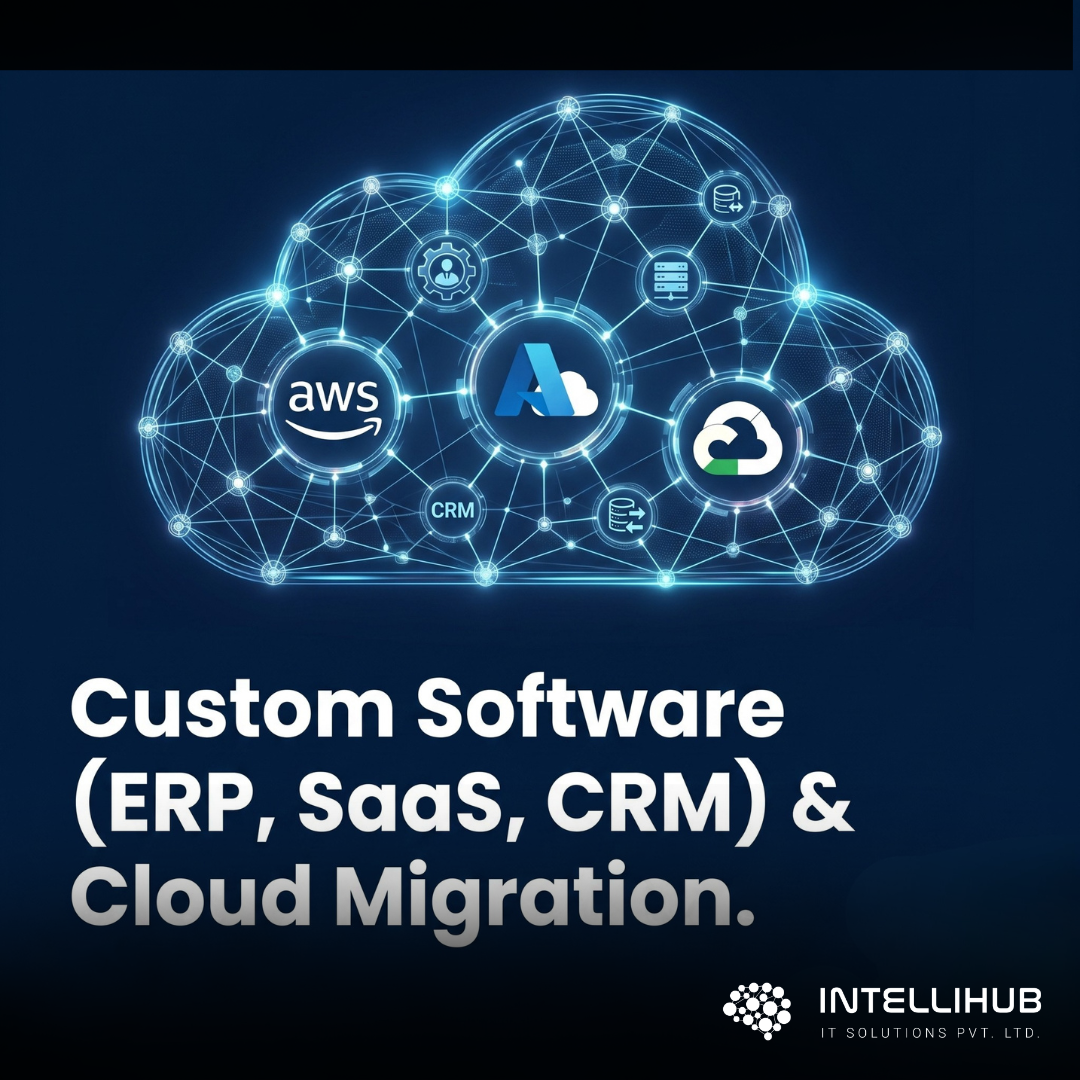
The business landscape in 2026 leaves little room for digital inefficiencies. Off-the-shelf software often comes with rigid plans and recurring subscription costs. It can also lock your data into closed...
Not just metrics — milestones earned by our clients and our team.
Book a free plant assessment. We’ll walk your floor, identify the highest-value monitoring opportunities, baseline your current downtime costs, and give you a clear deployment plan with a projected ROI — before any commitment.
Your trusted technology partner, building solutions that drive real growth.
Software Development
Cloud Services
Consulting
Mobile App Development
Digital Marketing
© 2026 Created with Intellihub IT Solutions
This website uses cookies to ensure you get the best experience on our website.