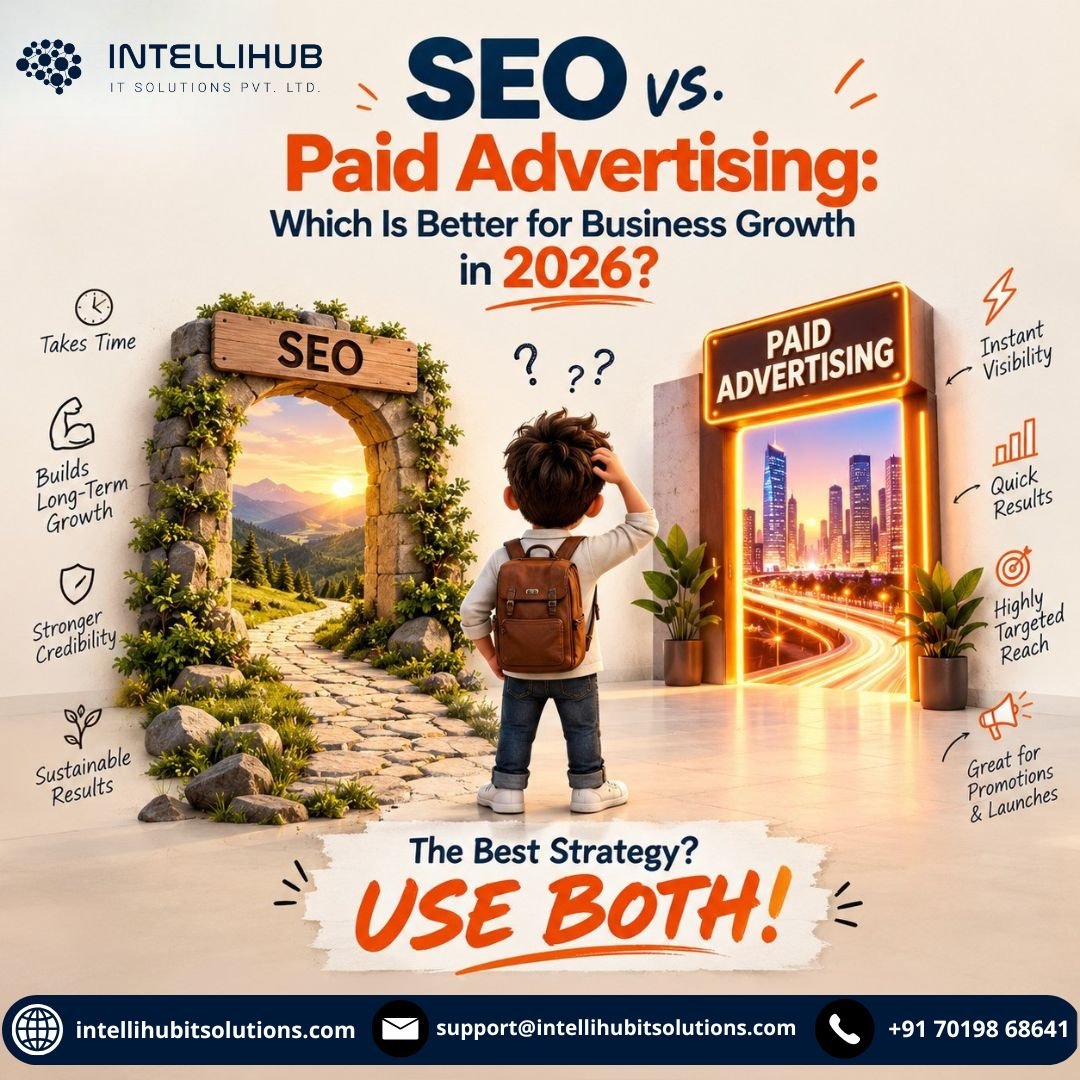
Choosing between SEO vs paid advertising is an important decision for businesses that want to attract customers, generate qualified leads, and grow online. While some companies focus on improving their organic search rankings, others invest in paid campaigns to reach potential customers more quickly. Both approaches can support business growth, but they work differently and require different levels of investment, planning, and patience.
The right choice depends on your business goals, budget, target audience, competition, and expected timeline. In this guide, we’ll compare SEO and paid advertising, explain their benefits and limitations, and help you decide which approach best suits your business.
1. What Is SEO?
Search engine optimization (SEO) is the process of improving a website’s visibility in organic search results. When people search Google for products, services, or solutions, SEO helps businesses make their websites more relevant and useful to those potential customers.
Unlike paid advertising, businesses do not pay Google for every click on an organic search result. However, SEO requires investment in content creation, website improvements, technical optimization, and ongoing maintenance.
How Does SEO Work?
SEO involves several activities:
- Keyword research: Identifying the terms potential customers use when searching online.
- On-page SEO: Optimizing page titles, headings, content, and internal links.
- Technical SEO: Improving website crawling, indexing, and performance.
- Content marketing: Publishing helpful articles, guides, and service pages.
- Link building: Earning relevant backlinks from credible websites.
- User experience: Making the website easy to navigate on different devices.
These activities help search engines understand your website and help visitors find useful information.
For additional guidance, businesses can refer to Google’s SEO Starter Guide to understand how search engines discover and understand website content.
Example of SEO
Imagine a software development company that wants to attract businesses looking for custom applications.
The company publishes helpful articles about software development costs, technology choices, and selecting a reliable development partner. It also improves its service pages and website performance.
Over time, these pages may appear in relevant organic search results. Potential customers can discover the content, explore the company’s services, and submit enquiries.
SEO does not guarantee rankings or immediate results. However, useful content can continue attracting relevant visitors over time.
2. What Is Paid Advertising?
Paid advertising is a digital marketing approach in which businesses pay to display advertisements to selected audiences.
These advertisements can appear on search engines, social media platforms, and other digital channels.
One common approach is pay-per-click (PPC) advertising, where advertisers often pay when someone clicks an advertisement. Other campaigns may charge based on impressions or specific actions.
Google Ads is a popular option for businesses that want to reach people actively searching for particular products or services.
How Does Paid Advertising Work?
A typical campaign involves:
- Defining a clear marketing objective.
- Identifying the target audience.
- Selecting an appropriate advertising platform.
- Creating relevant advertisements.
- Setting a realistic budget.
- Directing visitors to a suitable landing page.
- Measuring performance and optimizing the campaign.
Paid advertising can generate visibility soon after a campaign is approved and launched. However, visibility does not guarantee enquiries or sales.
Campaign performance depends on competition, targeting, advertising quality, landing-page experience, and the strength of the offer.
Example of Paid Advertising
Suppose a cloud consulting company wants to attract businesses planning to migrate their infrastructure.
It launches a Google Ads campaign targeting relevant searches and directs visitors to a dedicated cloud migration landing page. Interested visitors can request a consultation through an enquiry form.
The company then evaluates its advertising expenditure, qualified enquiries, and resulting sales.
If the campaign produces valuable leads at an acceptable cost, the company can consider increasing its investment. Otherwise, it can improve its targeting, advertisements, or landing page.
3. SEO vs. Paid Advertising: Key Differences
SEO vs paid advertising is an important comparison for businesses deciding how to attract potential customers.
Traffic source: SEO attracts visitors through unpaid search results, while paid advertising generates traffic through sponsored placements.
Time to visibility: SEO usually requires consistent effort before meaningful results develop. Paid advertising can provide visibility shortly after a campaign launches.
Cost structure: SEO involves content, technical improvements, expertise, and maintenance. Paid advertising requires campaign spending and potentially additional management costs.
Long-term potential: Successful organic pages may continue attracting visitors over time. Paid traffic generally depends on continued advertising.
Budget control: SEO investment can be planned, but rankings cannot be guaranteed. Paid campaigns offer more direct control over spending limits.
Testing opportunities: Paid advertising can help test offers and landing pages, while SEO can help businesses build lasting organic visibility.
Measurement: Both strategies should be evaluated using conversions, qualified leads, and customer acquisition costs.
Neither approach guarantees business growth. The right choice depends on whether your business needs faster exposure, long-term visibility, or both.
4. SEO vs Paid Advertising: Which Offers Better Value?
Cost is an important consideration when choosing a digital marketing strategy. However, comparing SEO and paid advertising requires looking beyond the initial investment.
Understanding SEO Costs
SEO expenses may include keyword research, content writing, technical improvements, website development, and performance monitoring.
Some businesses manage SEO internally, while others hire specialists or agencies.
Although businesses do not pay for each organic click, SEO is not free. It requires time, expertise, and ongoing work. Its potential advantage is that successful pages may continue generating relevant traffic without a separate payment for every visit.
Understanding Paid Advertising Costs
Paid advertising costs include platform spending and expenses associated with campaign management, creative production, landing pages, and tracking.
Actual costs vary depending on industry, competition, audience, location, and advertising platform.
A campaign with inexpensive clicks can still perform poorly if visitors do not become customers. Similarly, a campaign with higher costs may be worthwhile if it generates profitable sales.
Businesses evaluating paid search campaigns can compare their results with industry benchmarks for click-through rates, conversion rates, and cost per lead.
The most useful comparison is the total investment required to generate qualified leads and acquire customers. Traffic volume and cost per click alone do not determine profitability.
5. SEO vs Paid Advertising: How Long Does Each Strategy Take?
The time required to see results is another important difference.
SEO Takes Time
SEO involves improving a website’s relevance, technical condition, content, and visibility in organic search results. When comparing SEO vs paid advertising, businesses should remember that SEO typically requires consistent effort before meaningful results develop.
New websites and highly competitive industries may need considerable time and effort before meaningful growth appears.
Google explains that SEO improvements can take several months to produce noticeable benefits, although timelines vary.
Factors influencing results include website condition, competition, content quality, search demand, and the resources invested.
Businesses should set realistic milestones rather than expecting immediate rankings.
Paid Advertising Can Deliver Faster Visibility
Paid advertising can begin reaching potential customers shortly after a campaign is approved and launched.
This makes it useful for promoting limited-time offers, testing new services, or reaching audiences while an SEO strategy develops.
However, campaigns may require testing before they generate profitable results. Some campaigns may never achieve an acceptable return.
Choose SEO when your priority is building long-term organic visibility. Consider paid advertising when you need faster exposure and have a suitable budget and conversion process.
6. SEO vs Paid Advertising for Small Businesses and B2B Companies
Small businesses and B2B companies often have limited budgets and need to make careful marketing decisions.
SEO for Small Businesses
SEO can help small businesses become more visible when potential customers search for relevant services.
For example, an accounting firm could publish helpful information about bookkeeping, tax preparation, and financial planning. By improving its website and creating relevant content, the firm may attract customers through organic search.
Local SEO can also help businesses reach customers in their service areas.
Paid Advertising for Small Businesses
Paid advertising may be useful when a business wants to promote a specific offer or test demand for a service.
For example, a business launching a consulting service could run a controlled campaign and measure the quality of incoming enquiries.
Starting with a realistic budget helps the business evaluate performance before committing more resources.
What About B2B Companies?
B2B purchases often involve longer decision-making processes. Potential customers may compare providers, review case studies, consult colleagues, and request proposals before choosing a partner.
SEO can support this process through useful articles, service pages, and detailed guides. Paid advertising can help businesses reach people searching for specific services.
For B2B companies, lead quality matters more than traffic volume. Five enquiries from suitable potential customers may be more valuable than 50 enquiries from people unlikely to buy.
7. Can SEO and Paid Advertising Work Together?
Yes. SEO and paid advertising can complement each other when they support the same business objectives.
Use Paid Advertising to Test Offers
Suppose your business introduces a new digital marketing service. You could launch a controlled advertising campaign to test the offer and evaluate audience interest.
The results may help you understand which messages attract relevant enquiries, although a small campaign may not provide enough data to establish reliable demand.
Use SEO to Build Long-Term Visibility
Once you understand your audience’s questions, you can create useful content around those topics.
For example, a digital marketing company could publish an article explaining how businesses should evaluate SEO services and marketing costs. The article could link to its service page, helping interested readers explore its offerings.
Over time, this content may attract organic visitors.
Improve Your Website Using Performance Data
Insights from both channels can help businesses improve service descriptions, calls to action, enquiry forms, and landing pages.
A combined strategy can diversify traffic sources, but it does not guarantee better results. Each channel needs a clear objective, appropriate investment, and consistent measurement.
8. How to Choose the Right Digital Marketing Strategy
Before investing in SEO, paid advertising, or both, consider five questions.
1. What is your primary business goal?
SEO may be a priority if you want to build organic visibility. Paid advertising may be more appropriate for testing a new offer or promoting a time-sensitive campaign.
2. How quickly do you need results?
Paid advertising can provide faster exposure, while SEO generally requires more time. Businesses seeking both immediate exposure and long-term growth may consider both.
3. What is your realistic budget?
Account for content, website improvements, campaign management, advertising spending, and conversion tracking.
4. Can your website convert visitors?
Before increasing traffic, ensure your website clearly explains your services and provides an easy way for visitors to contact you.
5. How will you measure success?
To measure SEO performance, track organic traffic, search visibility, and qualified leads. Paid advertising results can be evaluated through campaign spending, conversion rates, and cost per lead. By comparing both channels with actual sales wherever possible, businesses can understand which strategy delivers better results.
Businesses can also use Google Search Console to monitor their website’s search performance and understand how their pages appear in Google Search.
Businesses can also use Google Analytics to understand website traffic, analyse visitor behaviour, and measure important actions such as form submissions.
9. Frequently Asked Questions
1. Is SEO better than paid advertising?
Neither is universally better. SEO supports long-term organic visibility, while paid advertising can provide faster access to selected audiences. The right choice depends on your goals, budget, and timeline.
2. Is SEO cheaper than Google Ads?
SEO does not involve paying Google for each organic click, but it requires investment in expertise, content, and website improvements. Google Ads requires advertising spending and may involve management costs. Compare the total investment with the value generated.
3. How long does SEO take to work?
SEO timelines vary depending on competition, website condition, and content quality. Meaningful improvements may take several months or longer, and specific rankings cannot be guaranteed.
4. Can small businesses succeed with paid advertising?
Yes. Small businesses can use paid advertising with a relevant offer, realistic budget, suitable targeting, and reliable conversion tracking.
5. Should businesses use SEO and paid advertising together?
They can. SEO supports long-term visibility, while paid advertising can help test offers and reach audiences more quickly. The balance depends on business goals and available resources.
6. Does Google Ads improve organic rankings?
No. Paying for Google Ads does not directly improve a website’s organic search rankings. Paid advertising and organic search operate through different systems.
7. How can I measure digital marketing success?
Track qualified leads, conversion rates, customer acquisition costs, and revenue, alongside channel-specific metrics such as organic traffic and advertising costs.
Conclusion: Choose the Right Strategy for Sustainable Growth
SEO vs paid advertising is an important decision for businesses choosing the right digital marketing strategy, as both approaches offer different benefits and solve different problems.
SEO helps businesses build organic visibility through relevant content, technical improvements, and ongoing optimization. Paid advertising allows businesses to purchase exposure, test offers, and reach selected audiences within a defined budget.
For some businesses, SEO will be the primary focus. Others may benefit from paid advertising because they need faster exposure. Many businesses can use both approaches when their resources and objectives justify the investment.
Before choosing a strategy, consider your audience, budget, website readiness, and business goals. Establish clear performance measures and review your results regularly.
Ultimately, digital marketing is not just about attracting more website visitors. It is about helping the right people discover your business, understand your services, and become customers.
At Intellihub IT Solutions, we help businesses explore digital marketing opportunities through services such as SEO, website optimization, and digital strategy.
Ready to strengthen your online presence? Contact Intellihub IT Solutions to discuss your digital marketing goals and identify opportunities for business growth.